
AZRS - Switching of supplies
 Synchronous and quasisynchronous switching
 Advanced Reliability Improvement Algorithms
 Updated since 1995
Power changeover automation devices are among the basic systems affecting the reliability of power supply to loads. The algorithms and settings used in them have a fundamental influence on, among other things:
- the depth of voltage sinks,
- the value of the self-start currents and the surge electromechanical moments of the switching motors.
The values of the self-starting current and the impact electromechanical torque of the motor are determined by the value of the residual voltage and the phase angle contained between it and the line voltage at the time of motor reclosing. Due to the insulation strength of standard motors, it is assumed that the switching voltage should not exceed the value of 1.4 Un, which at the same time is a condition for ensuring that the allowable values for stator current and electromechanical shock torque of typical motors are not exceeded. Failure to meet these conditions often leads to serious motor failures. Damage to motors, interruptions of power supply to loads cause disruptions/ interruptions in technological processes and, consequently, generate serious financial losses. Thus, automation systems must implement power supply switching in a fast, safe and reliable manner. It is best to realise the changeovers in a synchronous manner (uninterruptible or with a short interruption) or in a quasi-synchronous manner. Detailed requirements for algorithms and settings of supply changeover automatics devices depend on the type of supplied consumers, requirements of specific technological processes and the quality/strength of the reserve supply source. Apart from realizing the function of automatic changeover reserve (ARS) and automatic changeover reverse (ARR), supply changeover automatics should also enable scheduled supply changeover (PSAP) and automatic supply switching (ASS). The automatic realization of PTS ensures fast and reliable switching eliminating possible delays and errors occurring in the manual switching process.
Modern automatic systems for power supply switching must meet many different requirements, and above all they must operate quickly, reliably and safely.
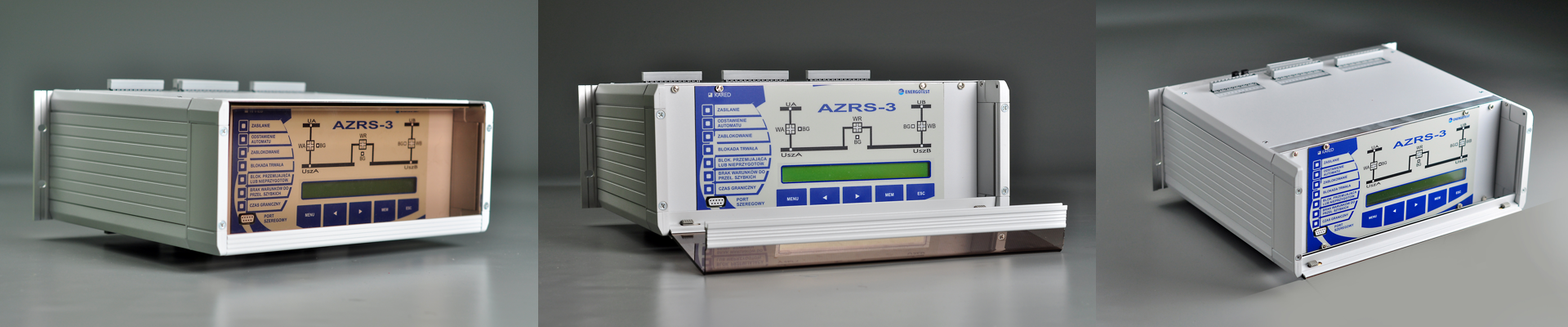
Automatics of the AZRS type are intended for operation in MV and LV switching stations supplying important motor or non-motor loads having a significant impact on technological processes. They are used both in systems with explicit (AZRS2) and latent (AZRS3) reserve. These automats are constructed on the basis of dedicated controllers. They are equipped with a front panel on which the switchgear synoptics are displayed. Information about the voltage values and the switches made is presented on a liquid crystal display.
Automations of the AZRS type perform switching in the following cycles
- SIM in fast mode (required for switchgears supplying motor loads) synchronous uninterruptible and synchronous
with a short interruption; - SIM in quasi-synchronous mode;
- SZR in slow mode;
- SZR in all directions;
- SPP carried out automatically after the voltage-stimulated EMS has been performed and the switchgear's primary supply voltage has recovered;
- PPZ in uninterruptible mode;
- PPZ in synchronous mode with short-term power interruption;
- PPZ in quasi-synchronous mode;
- PPZ in slow mode.
The AZRS automatics also allow
- independent supplementary voltage control;
- free declaration of the switchgear's primary power supply.
.