
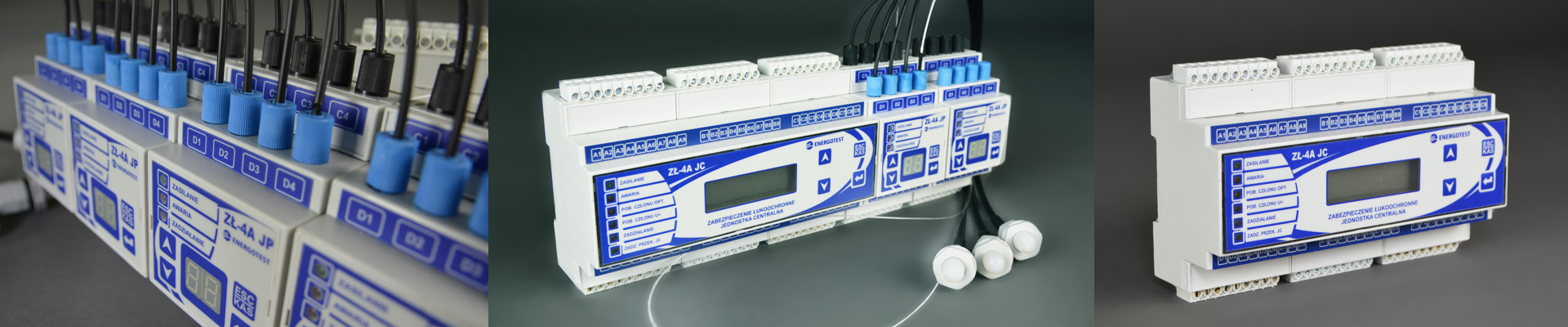
ZŁ-4A - Arc Flash Protection Device
 Protects human life and equipment
 Fast tripping
 Autonomous
 Selective tripping capability
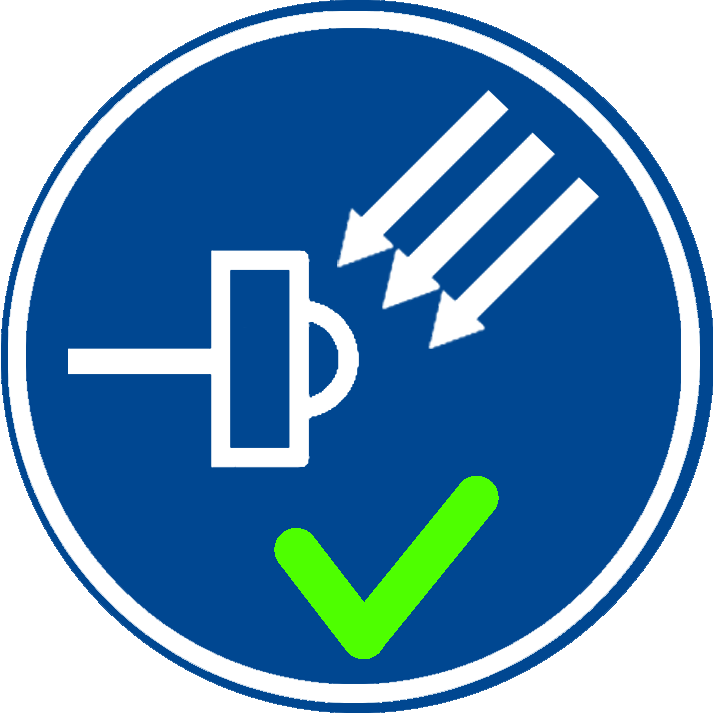 Arc detection using front sensors
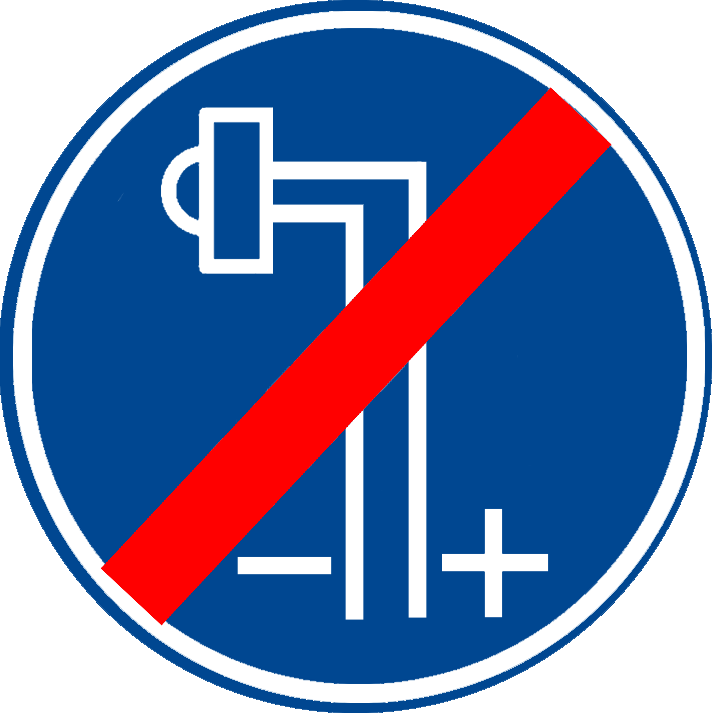 Voltage-free sensor connections
 Arc detection using fibre optic loops
 Self-testing of system performance and fibre optic continuity
 Many years of experience
Significance of the problem
According to official statistics from the National Labour Inspectorate, more than a dozen people are killed and dozens suffer serious injuries each year as a result of arc faults. Electrical equipment in which an arc fault has occurred is usually damaged to such an extent that it must be replaced. In some cases, total losses, including downtime costs, amount to several million PLN.
The most common cause (60%) of arc faults is human error, including incorrect connections and poor work organisation. To protect people and equipment from the effects of short circuits, technical standards such as PN-EN 62271-200, PN-88/E-05150 and PN-IEC 439-1 (defining requirements for MV and LV switchgear and transformer stations) recommend, in addition to proper equipment design, the use of additional measures to reduce arc fault effects.
One of the recommended solutions is arc flash protection based on light detection. This is the fastest and most effective way to minimise the consequences of arc faults.
Our proposal
In ZŁ-type arc flash protection systems, arc fault detection is based on two criteria: detection of arc light and a voltage drop within the protected zone.
The trip signal is generated in less than 10 ms. The arc is extinguished within 30–50 ms, depending on the type and condition of the circuit breaker. This response time ensures full protection of human life and health and minimises equipment damage.
The use of the voltage drop criterion ensures protection of the entire switchgear (no dead zones). It also enables correct operation in systems where a switchgear section is supplied from multiple sources. Protection systems based solely on current criteria do not provide these advantages.
ZŁ-4A - Arc Flash Protection for metal-enclosed switchgear with full selectivity
The ZŁ-4A arc flash protection system is designed for metal-enclosed MV/LV switchgear. It features a distributed architecture.
The central unit is typically installed in the voltage measurement panel, while field units are installed in individual switchgear panels. Optical front sensors (4 per unit) are installed in each compartment.
In the event of simultaneous detection of an arc and a voltage drop to 0.7 Un, depending on the fault location, the following circuit breakers are tripped:
- the circuit breaker of the affected panel – fault in zone 2 (cable/connection compartment),
- the circuit breaker of the incoming feeder panel – fault in zone 1 (breaker or busbar compartment),
- the nearest upstream circuit breaker – fault in the supply feeder.
Selective tripping capability is a key feature of the ZŁ-4 arc flash protection system, highly valuable from both operational and economic perspectives.
Design
The ZŁ-4A arc flash protection system consists of:
- central unit ZŁ-4A JC,
- power supply unit,
- field units ZŁ-4 JPA.
Each field unit is equipped with 4 optical sensors. Communication between units is performed via a fast CAN bus. Power supply circuits are distributed in parallel with the CAN bus.
The central and field units are mounted directly on TS rails.
Dimensions:
- central unit: 159 / 90 / 58 mm,
- field unit: 53 / 90 / 58 mm,
- protection class: IP20.
Up to 99 field units can be connected to a single central unit.
Thanks to its distributed architecture, the ZŁ-4 system offers a relatively low unit cost of protection per switchgear panel.
Central unit ZŁ-4A JC
Basic functions of the central unit:
Basic functions of the central unit:
- supervision of correct system operation
- configuration of protection settings
- provision of protection status information
- generation of trip signals
- blocking of ATS automation
- signalling of single-criterion operation
- RS485 communication (Modbus RTU)
- trip indication
- device fault indication
- 6 programmable trip contacts
- 2 signalling contacts with common potential
- possibility to test sensors of selected field units and configure self-test intervals
ZŁ-4A JP field units
Basic functions of the field units:
- detection of arc light within the protected switchgear section
- generation of trip signals
- transmission of alarm signals to the central unit
- user testing of fibre optic sensors and cyclic self-test (e.g. every 24 hours)
Front optical sensors
The sensors are characterised by an appropriate light sensitivity level. Sensitivity is adjusted depending on sensor length and site conditions. It must be set to prevent false operation due to ambient light (e.g. sunlight or operator lighting).
Standard fibre optic sensor cable lengths are 3 m, 5 m and 15 m.
Effects of arc faults in electrical systems not protected by fibre-optic arc protection
Approximately 70% of electrical accidents are caused by arc faults. In medium-voltage systems, this share can reach up to 90%.
Short-circuit currents in MV equipment range from several to tens of kA. In addition to technical and environmental causes (design defects, ageing, corrosion, overvoltage, vibration, rodents), human error remains the dominant factor.
During prolonged arc faults:
- temperatures can reach up to 20,000°C,
- explosive pressure waves occur,
- equipment is destroyed,
- large amounts of hot and often toxic gases are released.
Such conditions pose a severe threat to human life and health.
The thermal energy of a short circuit depends on two factors: current and duration (Q = I²t). Only the time factor can be effectively reduced.
Arc duration below 100 ms does not cause significant damage, while durations above 500 ms lead to irreversible damage (melting of copper and steel), requiring equipment replacement and causing downtime.
In traditional overcurrent protection systems, operating times may reach up to 2.5 seconds.
In Poland, several hundred arc fault incidents occur annually, causing injuries. The total number of arc faults is unknown but is estimated to be in the thousands each year.
Benefits of fibre optic arc flash protection
ZŁ-type arc flash protection systems have been in operation for over 10 years, with more than 1,000 installations.
They detect faults and generate trip signals in less than 10 ms. Combined with modern circuit breakers, this enables fault clearing in under 30 ms.
This significantly reduces the effects of arc faults, improving both personnel safety and equipment reliability.
The requirement for simultaneous detection of light and voltage drop ensures highly reliable operation. No cases of malfunction or incorrect operation have been reported.
Below are selected examples demonstrating the effectiveness of ZŁ-type arc flash protection systems.
.