
DCtest2 - Ground fault monitoring
 Fast-measurement
 Measurements without disconnecting feeders
 Portable clamp-based locator
 High resistance to interference
 Detection of all types of short circuits
 High accuracy regardless of network capacity
 Detection of faults between battery systems and feeders of different sections
Challenges in DC networks
DC networks are among the most critical systems in power facilities. Their reliable operation is essential for the proper functioning of control, regulation, measurement, and protection systems.
These networks are often very extensive, with lengths reaching up to 100 km. As a result, they are highly exposed to external factors that degrade insulation.
The most common causes of insulation deterioration include:
- contamination or moisture
- mechanical damage
- ageing
- installation errors and insufficient maintenance
Short circuits in DC networks may lead to malfunction or complete failure of control and protection systems, posing a serious risk to both equipment and human safety.
Continuous monitoring of insulation resistance, as well as precise fault location and rapid elimination, is therefore crucial.
Traditional methods (such as the voltmeter method or measuring relays) require disconnecting parts of the network or even intentionally short-circuiting conductors. These approaches are time-consuming, disruptive, and often impossible during normal operation. They also do not support preventive maintenance.
System description
The DCtest2 system is a microprocessor-based solution designed for monitoring insulated DC networks in the voltage range of 24–220 V.
Accurate operation under high interference conditions is ensured by advanced signal compensation and filtering techniques.
The system:
- continuously measures insulation resistance of the entire network
- monitors individual feeders
- measures insulation relative to earth and other grounded circuits (e.g. 230/400 V AC)
Measurement results are displayed on the central unit and can be transmitted to supervisory systems.
System design:
The system consists of the following components:
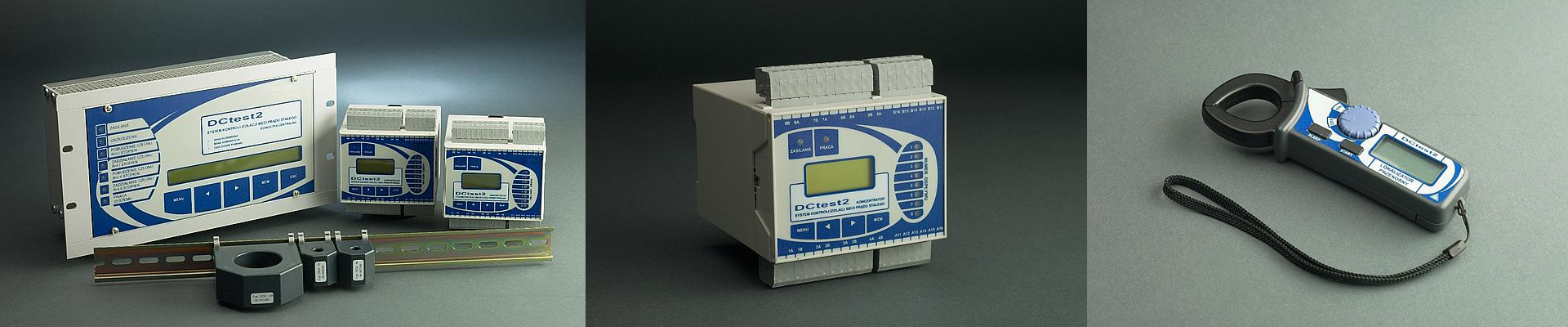
- Central unit (DC2-jc)
- Stationary measuring transformers:
- DC2-I9 (Ø9 mm)
- DC2-I13 (Ø13 mm)
- DC2-I43 (Ø43 mm) - Concentrators (DC2-k) – up to 8 transformers per unit
- Portable fault locator (DC2-p)
All components communicate with the central unit via RS485.
Central unit DC2-jc
The central unit is the core of the system and includes:
- insulation resistance calculation for the entire network
- multi-stage signalling system with time delay
- internal and external alarm signalling
- LCD display for measurement visualisation
- communication with concentrators and other central units
Concentrator DC2-k
The concentrator processes signals from measuring transformers and calculates earth fault currents.
It enables reading:
- earth current values
- insulation resistance of individual feeders
Stationary measuring transformers DC2-I9, DC2-I13, DC2-I43
Installed on feeders, they measure earth fault currents.
- Number depends on system size
- Up to 100 (optionally 200) transformers per central unit
Portable locating device DC2-p
The portable device complements the stationary system and enables:
- measurements in locations without installed sensors
- precise fault localisation
It uses clamp sensors measuring both conductors (positive and negative). By comparing current values, the operator can identify the fault location.
Basic features of the DCtest2 system
- detection of all types of faults: metallic short circuits, faults through relay coils, double earth faults, earth faults, faults to other grounded networks (e.g. 230/400 V AC),
- pulse generator with high internal resistance (20 kΩ), which does not activate auxiliary relays,
- pulse frequency adjusted to network capacitance,
- simultaneous measurement of the entire network and individual feeders,
- delayed alarm activation to verify measurement results,
- large and clear display showing insulation resistance of the entire network and individual feeders,
- textual identification of feeders,
- two independent adjustable alarm thresholds,
- system fault signalling (sensor failure, concentrator failure),
- communication with control and monitoring systems via:
- Modbus RTU,
- Modbus TCP,
- IEC 60870-5-103.
Benefits of using the DCtest2 system
- fast and precise fault location,
- support for preventive maintenance,
- improved safety of personnel,
- prevention of costly process downtime,
- protection against insulation degradation.
The system is used in power plants, combined heat and power plants, industrial plants and distribution substations of the National Power System.