
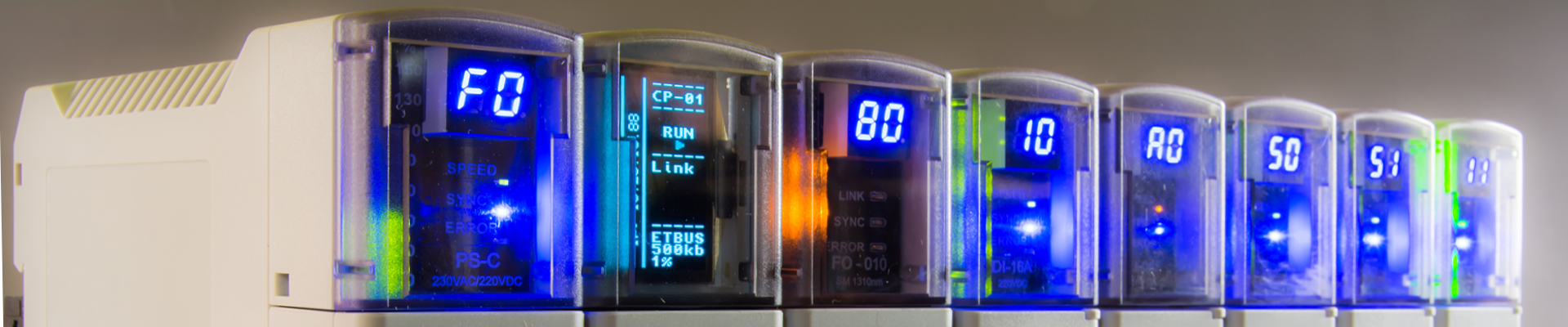
ET-DCS - Modular controller
The ET-DCS modular controller was developed thanks to Energotest's many years of experience in the design and manufacture of devices for the electrical power industry, which have been successfully used by customers for years.
 Analogue inputs and outputs 0/4..20mA, -10/0..10V, 0..1/2/5A
 Processor module redundancy capability
 Dual inputs and outputs 230VAC/220VDC/24VDC
 Wide range of communication protocols
 Protocol for double track communication PRP
 Possibility to replace modules without stopping the process
 Power redundancy capability
 Time-sync transmitted by input modules with 1 ms accuracy
 PTP, NTP, SNTP time synchronisation
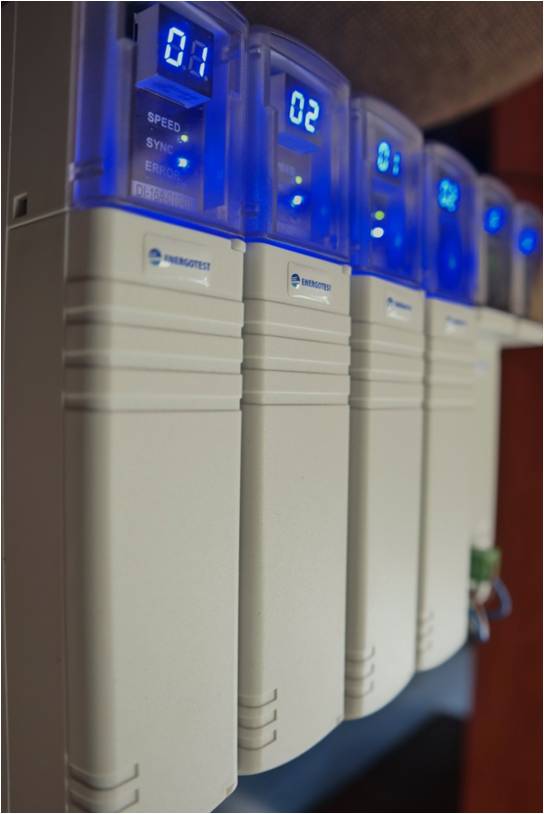
Modular design, a dedicated operating system, the use of COPA-DATA's straton programmable logic controller (PLC) code and free programming of the IEC 61131-3 compliant central unit (ET-CP) enable, via input/output modules, the acquisition, supervision and effective control of electrical power facilities as well as industrial processes. The input/output modules have an object interface operating at all common voltage and current levels (for two-state modules: 24VDC, 220VDC, 230VAC; for analogue modules: 0/4..20mA, 0..1/2/5A, -10/0..10V, 0-230V).
The controller is connected to the main communication bus via a 1Gb Ethernet interface (dual interface on Et-CP CPUs with integrated L2 switch).
Communication between the modules is achieved via a proprietary hybrid ET-BUS combining both event communication with cyclic and simultaneous separation of the transmission of large data packets (e.g. from analogue input modules) from binary, alarm or diagnostic signals. The ET-BUS allows the connection of up to 64 modules of various types both within a single cabinet and distributed. Either a copper or fibre-optic cable can serve as the medium for this connection. Thanks to the individual addressing of each module on the ET-BUS, there is no rigidly assigned installation location for the individual modules, which allows existing controllers to be freely extended with new modules or functionalities.
All modules, including input/output modules, have their own clock synchronised to an accuracy of 1ms, so that they give precise time-stamps to events or measurements, which are then transmitted to the ET-Server or any host system and recorded with the time-stamp given at the time of recording by the input module.
The modules are installed on a backplane, which, thanks to its unique design, can be freely configurable in size - from 1 to 64 slots - as required.
Communication capabilities with third-party devices are provided, in addition to two Ethernet ports, by the three RS485 serial communication ports available on the ET-CP unit, as well as by the EKM converter units available in Enenergotest's product portfolio. Combined with the possibility of using multiple communication protocols (including IEC61850, Modbus TCP, Modbus RTU), this provides us with virtually unlimited communication with any systems or devices.
An interesting and unique feature of the ET-DCS binary input/output modules is the ET-DirectLink function, which gives the possibility of direct data transfer between the input and output modules bypassing the central unit and without introducing additional delays. This feature makes it possible to significantly reduce the number of cable connections when transferring, for example, status and control information between a facility and a traditional desktop.
All modules have unified enclosures and are free of moving parts (fans).
Each module can be replaced live, while the plant is in operation.
Main features of the ET-DCS controller:
- programming in accordance with IEC61131-3
- programming in accordance with IEC61131-3
- modularity and ease of expansion
- up to 64 modules connected to the ET- bus.BUS
- galvanic separation of modules from the bus and input/output circuits from internal circuits
- redundancy of ET-PS power supplies, ET-CP control unit, communication with the host layer
- autodiagnosis of all modules,
- ET-PS power supplies with load monitoring and indication,
- time-stop resolution of 1ms,
- timestamp transmitted by the input modules
- synchronisation of each module's time with the central clock with an accuracy better than 1ms,
- binary inputs and outputs 230VAC/220VDC/24VDC
- analogue inputs and outputs 0/4..20mA, -10/0..10V, 0..1/2/5A